A Lightweight POS Is Not a Small POS: What Should a Restaurant Terminal Keep and Let Go?
A lightweight POS is not a half-sized feature set. It redraws the boundaries between the restaurant terminal, transaction hub, service-provider ecosystem, and data foundation. This article uses an outage scenario to identify what must stay at the restaurant and what should move upstream.
A note before we begin: My previous article discussed data decoupling, and argued that a lightweight POS plus an omnichannel transaction hub is a more sensible direction than replacing the existing system with an even heavier POS.
This article takes the phrase “lightweight POS” apart: what exactly becomes lighter, and what should a restaurant terminal keep or let go?
Imagine a restaurant group that has just launched a “lightweight POS + transaction hub” at a pilot location.
Opening goes smoothly. The hub pushes the menu, members are identified, and a price change from headquarters reaches every channel.
Then, during the dinner rush, the restaurant network goes down. A cashier tries to apply a regular customer’s promotion, but the screen says it cannot connect. The manager wants to mark the sold-out soup unavailable, only to discover that the rule exists only in the hub. The kitchen asks about the status of a delivery order, while the terminal and the platform show different answers.
Once functionality has been moved out, the restaurant discovers that it did not move only buttons. It also moved the question of who is responsible when something fails.
Why “lightweight” is often mistaken for “less”
When restaurant owners hear “lightweight POS”, many first think of a cheaper, simpler cash register for small restaurants.
That product category has its place. It solves low-cost setup for a small shop. It does not solve how a restaurant group should divide its systems.
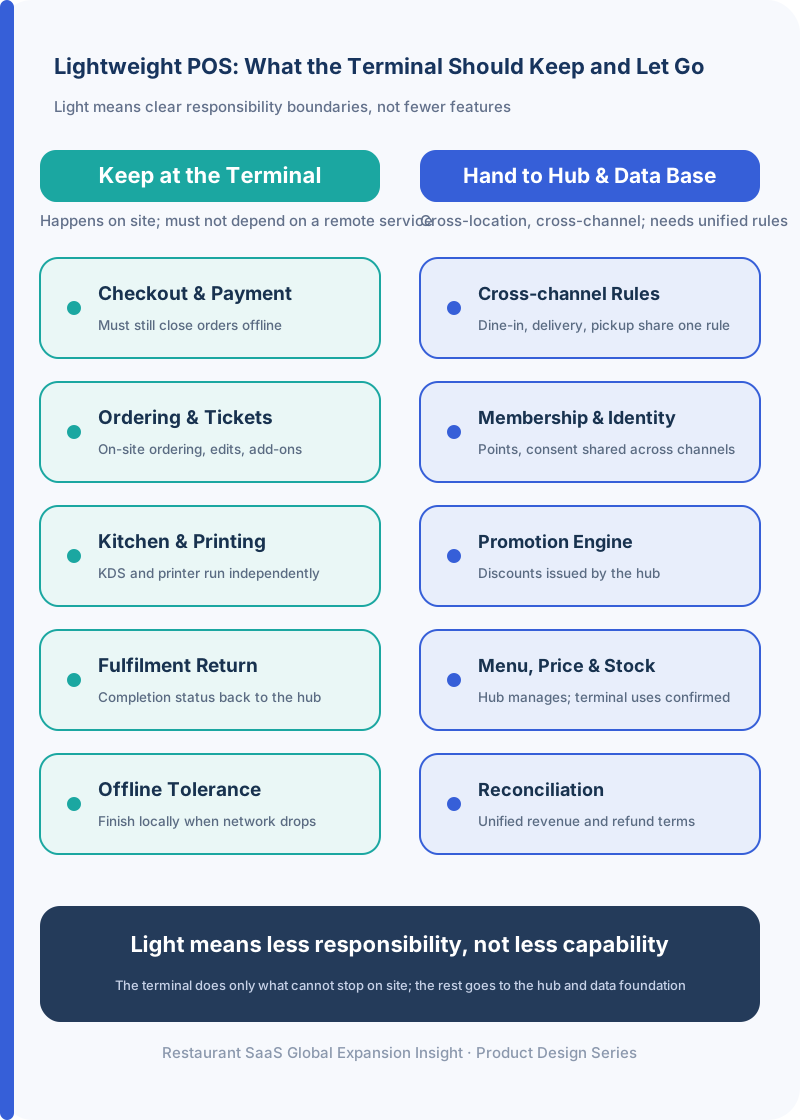
A lightweight POS is not a half-sized POS, nor is it a terminal that can only open a web page. It changes where responsibilities live: the restaurant keeps capabilities that cannot stop on site, while the transaction hub and other systems take care of rules that span channels, locations, and markets.
My rule of thumb is:
The closer a capability is to on-site execution, and the less the restaurant can afford to lose it, the more it belongs at the restaurant. The more a rule spans channels, locations, or markets, the less it should be embedded in the POS.
A lightweight POS is therefore an outcome of decoupled data and responsibilities, not simply a cheaper cash register.
Five questions to ask first
To decide whether a capability belongs at the restaurant, ask:
- If it disappears or slows down, does frontline service stop immediately?
- Is it on-site execution, or a shared rule across channels and locations?
- Must it continue when the network is unavailable?
- Does the whole group need to use the same definition?
- When something goes wrong, which system must provide the final answer?
The answers usually place a capability in one of four groups: keep it at the restaurant, move it out of the POS, decide by market, or do not make the terminal responsible for it at all.
Category one: capabilities that must stay at the restaurant
These capabilities happen on site and cannot depend entirely on a remote service.
Ordering and order confirmation
The restaurant needs to create, modify, and confirm orders, including products and options, additions, removals, cancellations, table numbers, pickup numbers, and necessary service notes.
Even when an order comes from an external channel, the restaurant must know what it is accepting, how it should be executed, and its current status.
Checkout, payment, and refund execution
The upper platform can manage payment-provider connections, routing, and reconciliation rules. The restaurant still needs to collect payment, confirm the result, process refunds and voids, handle exceptions, and record staff permissions and actions.
A lightweight POS does not need to understand every detail of every market’s payment ecosystem. It cannot lose the ability to complete and confirm an on-site transaction.
Kitchen dispatch and fulfilment
The terminal turns an order into work on the floor: printing or sending it to the KDS, routing it to the right preparation area, updating acceptance and preparation status, and handling shortages, delays, and cancellations.
The transaction hub can standardise status definitions. The restaurant is still the place that knows whether a dish has actually been completed.
Basic restaurant controls
Opening, shift handover, closing, cashier permissions, the cash drawer, cash variances, same-day transaction lookup, and necessary audit records are part of the shift itself.
They cannot simply fail because headquarters or an external service is temporarily unavailable.
Continuity during network problems
A lightweight POS does not mean every capability depends on the cloud in real time.
The restaurant needs clear answers: can it continue taking orders when the network is down? Can orders still reach the kitchen? Which payment methods remain available? How are data and conflicts handled after the connection returns?
If one network failure stops the whole restaurant, the system is not lightweight. The risk has merely moved from the local system to the network.
Category two: capabilities the POS should let go
These capabilities span locations or channels, or require shared rules and data. Keeping them on every terminal creates duplication and mismatches.
Individual rules for every external channel
Delivery, pickup, dine-in, and group-buying channels may each have their own product mappings, order statuses, refund flows, operating hours, service fees, and promotion rules.
The transaction hub or integration platform should handle those differences. The POS should receive a standard order that the restaurant can understand and execute.
This follows the point made in multi-platform delivery order integration: integration is not just putting orders on one screen. The orders must enter one fulfilment workflow.
Group-level product, pricing, and marketing rules
The POS needs an executable menu, but it should not be the only source of product rules.
The group product catalogue, location pricing, channel pricing, bundles, promotions, coupons, and market-specific menu versions are better managed upstream. The restaurant can keep the current usable version and the necessary cache; the final definitions should not be scattered across POS terminals.
Full membership and customer relationship management
The POS needs to identify a customer, apply a membership benefit, and record the transaction. It does not need to own the complete CRM.
Segmentation, cross-channel identity resolution, follow-up campaigns, customer consent, review records, and service history all operate across locations and channels. As discussed in who should control the customer relationship, customer identity is a cross-channel asset, not a local file on one terminal.
Cross-channel order orchestration
Which platform sent an order, which location should fulfil it, and which product and fulfilment rules apply should be resolved by the transaction hub.
The POS does not need to understand every channel. It needs to execute a confirmed order accurately.
Group reporting, data governance, and AI
Restaurants need to see their shift and same-day operations. Group-wide analysis, shared revenue and refund definitions, customer data governance, historical trends, anomaly detection, and AI recommendations should not depend on the POS.
The terminal should record and return accurate frontline facts. It should not become the group’s only data warehouse, BI platform, or AI gateway.
Category three: areas that cannot be decided with one rule
The harder product decisions are often neither “keep” nor “move”. Some capabilities need to be split according to the market and the operating context:
- tax and invoicing requirements;
- membership points and coupon redemption while offline;
- cash management and change;
- manager permissions and approval flows;
- payment methods that require locally certified hardware;
- language and currency support;
- the boundary between local sell-out status and group inventory.
These capabilities cannot be judged from a vendor’s standard architecture alone. Local compliance requirements, payment habits, network conditions, and restaurant workflows all affect where responsibility belongs.
This is also where localisation and customer customisation can easily be confused. A clear boundary becomes a reusable market capability. Building a separate version for every customer becomes endless customisation.
Category four: capabilities the terminal should not own
Head-office analysis, large data exports, cross-channel reconciliation spreadsheets, complex organisation management, and running a large language model directly on the terminal usually do not belong on the restaurant device.
They require data across locations, channels, and time, and they increase the terminal’s compute, maintenance, and upgrade burden.
As the terminal gets lighter, AI can see more clearly
If AI only uses data from one POS, it sees one location’s orders, refunds, and preparation times. It does not know whether other locations are also experiencing delays, or how delivery orders, customer reviews, and repeat purchases relate to one another.
Once the terminal focuses on recording facts—what was ordered, when it was placed, when it was prepared, what was sold out, and whether it was refunded—the transaction hub and data foundation can unify product, location, order, and metric definitions.
AI can then identify preparation delays across locations, connect a product’s refunds with a rise in poor reviews, or flag that delivery demand is rising while a restaurant is nearing its capacity. This follows the point made in AI in restaurant SaaS should be more than a chatbot: AI needs trusted, permissioned data and should not be locked inside one cash register.
The analysis should not stop in a head-office report. A result can return to the lightweight POS as a prompt for the manager to check a preparation step, extend the estimated pickup time, or pause an item. A staff member then confirms whether to act.
The lightweight POS has three responsibilities here: provide accurate frontline data, present a recommendation relevant to the current task, and execute the action after staff confirmation.
AI does not need to live inside the POS. Its judgement does need a route back to the restaurant.
Moving a capability out does not make it disappear
When a capability leaves the POS, it still needs a home and an owner.
| Capability | Primary responsibility | Role of the restaurant terminal |
|---|---|---|
| Delivery integration | Aggregation / integration platform | Receive standard orders and return fulfilment status |
| Membership and CRM | Membership platform / CRM | Identify members, apply benefits, record transactions |
| Payments | Payment platform and local providers | Initiate payment, confirm results, handle frontline exceptions |
| Marketing and promotions | Transaction / marketing hub | Read the applicable rule and execute redemption |
| Reporting and analysis | Data foundation / BI | Record and return accurate data |
| Supply chain | Head-office / supply-chain system | Return consumption, sell-out, and on-site status |
| AI | Data / operations platform | Provide frontline signals, show recommendations, accept confirmation, and execute |
Different markets can use different payment, delivery, membership, and local service providers. They should still connect to the group through shared interfaces. The terminal does not need to understand every provider’s internal rules; it needs to call a capability that has already been standardised.
That is what a lightweight POS means in a service-provider ecosystem: the terminal executes on site. It does not own every capability.
Moving responsibility also means defining support
Every capability that leaves the POS should have clear answers:
- Which system is the source of truth?
- Who owns the problem when a system is slow, unavailable, or inconsistent?
- Who does the restaurant contact, and what is the fallback process?
When everything lived in the POS, a failure could be described as “the terminal is broken”. After the split, the cause might be the local device, the restaurant network, the transaction hub, a payment provider, or a delivery platform.
Support must be split along with the architecture. Otherwise, staff make more calls during the busiest period without finding an owner.
The interface should show the same boundary. If an action needs hub data but the network is unavailable, the action should be visibly unavailable with an explanation. It should not simply disappear. Staff need to know what happened, what to do next, and what to tell the customer.
Three common mistakes
Mistake one: turning lightweight POS into a low-end POS
Removing features, lowering the price, and targeting small restaurants is product tiering. It is not lightweight architecture.
A lightweight POS can still serve a large restaurant group. It reduces the responsibilities carried by the terminal; it does not reduce the reliability required at the frontline.
Mistake two: moving everything to the cloud
If every order, change, and kitchen action depends on a remote service, the restaurant may stop operating when the network or upper platform fails.
Lightweight POS needs a clear split between local and cloud capabilities. It does not mean “put everything in the cloud”.
Mistake three: moving functions while duplicating the data definitions
If the POS, transaction hub, membership platform, and delivery platforms still maintain separate product, location, and order definitions, the system has only gained another layer. It has not become lighter.
Functions can be distributed. Responsibility and data definitions cannot remain ambiguous.
One ordinary shift is the real architecture test
A lightweight POS should not be rolled out to every location at once. Start with one pilot location. Define how the old and new systems will reconcile, when the operation must return to the existing process, and who can make that rollback decision.
Test the system through an ordinary but busy shift:
- At opening, are the menu, prices, taxes, and availability correct?
- During the rush, do ordering, changes, payments, printing, and kitchen fulfilment wait on the network or another service?
- During a simulated outage, can the local menu, checkout, printing, and basic fulfilment continue? How long can they run, and will staff need to reconcile data manually after reconnection?
- When a delivery order reaches the restaurant, do its status and sell-out information stay in sync?
- After a cancellation or refund, do the transaction, payment, and finance records reconcile?
- At closing, does the cash total match the system, or is a spreadsheet still needed?
A complete architecture diagram does not prove that a restaurant is ready. The real standard is simpler: on the first day, the restaurant can still complete a normal dinner service.
What should move first?
There is no need to change the whole system at once. Sequence the work by frontline risk and standardisation value:
- Start with rules that are easier to standardise and have lower frontline risk, such as cross-channel menus, membership, and promotions.
- Then move delivery order rules, reconciliation data, and cross-location reports.
- Change checkout, payments, refunds, and offline capabilities only after the preceding boundaries are stable.
Rather than beginning with an ideal feature list, start with one real delivery order and trace its responsibility: who receives it, who maps the product and price, who decides whether the restaurant accepts it, who sends it to the kitchen, who returns the preparation status, who handles cancellation and refund, and where the final record lives.
When those answers are clear, the POS is actually becoming lighter.
The same principle applies when choosing a POS: do not look only at the monthly fee or per-order pricing. Look at where the system puts complexity. Price determines what you pay; architecture determines how hard it will be to change later.
Conclusion: give away complexity, not frontline responsibility
The goal of a lightweight POS is not to make the POS do less. It is to let each layer do the work it is responsible for.
The restaurant terminal should retain transaction and fulfilment capabilities that cannot stop. It should let go of rules that span channels, locations, and markets.
The transaction hub standardises channels and workflows. The data foundation preserves shared definitions, permissions, and history. Service providers contribute specialist capabilities. The POS returns to the restaurant floor and makes sure each transaction can be completed.
A lightweight POS carries less responsibility, not less capability. When the restaurant gives away the complexity it should not carry, it can make the frontline work more stable.
🔧 Admin
Comments · 0 comments
Please use your name and stay on topic; abusive or spammy content will be removed.
Loading…